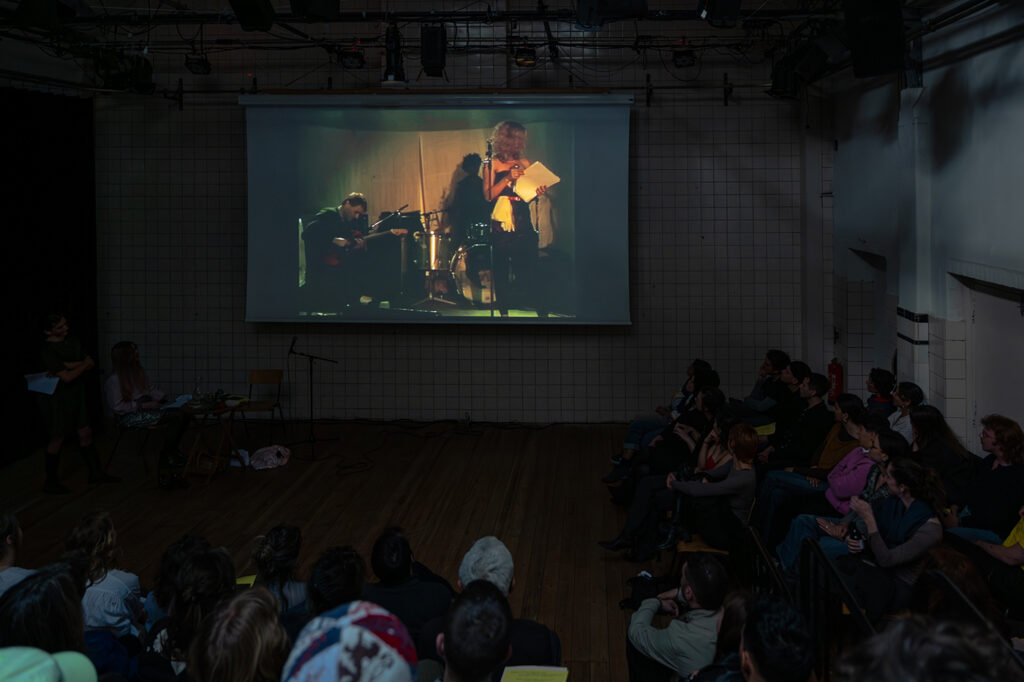
Prelude is a series of live events emphasising the interrelations and influences between moving image and performance, and between visual artists of distinct generations.
The concept is inspired by musical preludes, originally intended for musicians to tune their instruments before a concert, and show off their virtuosity for incoming audience members.
Prelude invites artists and audiences to ‘attune to one another’ and consider the theatre as a site for time-based visual art. In contrast to the individual viewing experience of the exhibition format, Prelude emphasises the audience’ collective presence and the theatre’s physical space as integral to the experience of the work.
The name Prelude suggests an opening to something new, something that is to come. Through encouraging collaboration and providing support, Prelude promotes new avenues for the invited artists and fosters new perspectives on their work.
Prelude is een serie live-evenementen waarin de onderlinge verbanden en invloeden worden verkend tussen bewegend beeld en performance enerzijds, en tussen beeldend kunstenaars van verschillende generaties anderzijds.
De reeks avonden is geïnspireerd op de muzikale prelude: oorspronkelijk bedoeld voor musici om hun instrumenten te stemmen voor een concert, en hun virtuositeit te tonen aan binnenkomend publiek.
Prelude nodigt kunstenaars en publiek uit om zich ‘op elkaar af te stemmen’ en het theater te beschouwen als een plek voor time-based beeldende kunst. In tegenstelling tot de individuele kijkervaring in een tentoonstelling, benadrukt Prelude de collectieve aanwezigheid van het publiek en de fysieke ruimte van het theater als wezenlijk onderdeel van de ervaring van het werk.
De naam suggereert een opening naar iets nieuws, iets dat komen gaat. Door samenwerkingen tussen kunstenaars te stimuleren, en ondersteuning te bieden, bevordert Prelude nieuwe wegen voor de uitgenodigde kunstenaars en biedt het nieuwe perspectieven op hun werk.
An audience must be won over, one by one.
This edition of Prelude, titled One by One, combines moving image, live performance and performance documentation, and considers the question of how the body is seen, heard, defined and restricted. Dutch performance and video art pioneer Lydia Schouten enters into dialogue with artist Astrit Ismaili. Brussels-based Amina Szecsödy invites the audience into a moment of collective tuning and a spotlight is turned on the radical oeuvre of Hugo Roelandt. Early and recent works by the four artists will converge this evening in an assemblage of live and projected images unfolding across space and time.
An audience must be won over, one by one.
Deze editie van Prelude, getiteld One by One, combineert videokunst, live performance en performanceregistraties en staat stil bij de vraag hoe het lichaam wordt gezien, gehoord, gedefinieerd en beperkt. De Nederlandse performance- en videokunst pionier Lydia Schouten treedt in dialoog met Astrit Ismaili. Daarnaast is er een bijdrage van de in Brussel gevestigde Amina Szecsödy, en is er aandacht voor het radicale oeuvre van Hugo Roelandt. Vroege en recente werken van de vier kunstenaars komen deze avond samen in een assemblage van live en geprojecteerde beelden die zich over ruimte en tijd ontvouwt.
Since the late 1970s, Lydia Schouten (*1948) has uncompromisingly shaped her position as a woman and as an artist, with the media’s influence as a recurring motif throughout her oeuvre. Working in a similar vein, Astrit Ismaili (*1991) explores the ‘transformative potential of body and space’ through the use of technology and sound. In their own ways the artists go beyond fixed ideas of identity and representation. Through their work they address social and structural constraints and invite us to expand the boundaries of our imagination. During this Prelude evening, the artists perform together.
Amina Szecsödy (*1995) is interested in historical views of the female body and voice as disruptors of power. She combines elements from the media, cinema and mythology, interweaving voices, images and stories from the past and future in the immediate present. For Prelude, the artist presents a reworked version of Mean Time, responding to the surrounding works. The collective voicing that opens the evening draws inspiration from a case described by Carl Jung, in which a woman believed she carried seven telephones inside her body.
Also on view is work by Hugo Roelandt (*1950–†2015), an artist who sought to deconstruct traditional notions of art and introduced a system-oriented approach to performance; replacing performers by machines, shifting focus to the audience’s role and emphasising art as a shared experience.
Addressing agency, autonomy and ‘being in relation’, this Prelude program invites you to experience a live program as an exhibition in motion.
‘An audience must be won over, one by one’ is the title of a painting by artist Sands Murray-Wassink, who was part of Prelude’s inaugural program.
Sinds eind jaren 1970 geeft Lydia Schouten (*1948) op compromisloze wijze vorm aan haar positie als vrouw en als kunstenaar, met de invloed van de media als terugkerend motief in haar oeuvre. Astrit Ismaili (*1991) onderzoekt het ‘transformatieve potentieel van lichaam en ruimte’ via technologie en geluid. Op hun eigen manier gaan de kunstenaars voorbij vaste ideeën over identiteit en representatie. Met hun werk richten ze zich op sociale en structurele beperkingen en nodigen ze ons uit de grenzen van onze verbeelding te verkennen. Tijdens deze Prelude-avond voeren de kunstenaars samen een performance uit.
Amina Szecsödy (*1995) is geïnteresseerd in historische opvattingen over het vrouwelijke lichaam en stem als verstoorders van macht. Ze combineert elementen uit media, cinema en mythologie, en vervlecht stemmen, beelden en verhalen uit verleden en toekomst in het directe heden. Voor Prelude presenteert de kunstenaar een herwerkte versie van Mean Time, die reageert op de omliggende werken. Het ‘collectieve stemmen’ waarmee de avond opent, is geïnspireerd op een casus beschreven door Carl Jung, waarin een vrouw geloofde zeven telefoons in haar lichaam te dragen.
Daarnaast is werk te zien van Hugo Roelandt (1950–†2015), een kunstenaar die traditionele opvattingen over kunst wilde deconstrueren en een systeemgerichte benadering van performance introduceerde: performers werden vervangen door machines, de nadruk verschoof naar de rol van het publiek en kunst werd een gedeelde ervaring.
Met aandacht voor zeggenschap, autonomie en ‘in relatie zijn’, nodigt dit Prelude-programma uit om een live programma te ervaren als een tentoonstelling in beweging.
* ‘An audience must be won over, one by one’ is de titel van een schilderij van kunstenaar Sands Murray-Wassink, die deel uitmaakte van het openingsprogramma van Prelude
A voice weaves through a collection of images, and somewhere between memory and imagination a story emerges. For this edition of Prelude, artists Pedro Barateiro and Agnieszka Polska bring their video work to the theatre – and with it their worlds, their language, their ways of seeing and thinking.
Een stem weeft zich door een verzameling beelden, en ergens tussen herinnering en verbeelding ontstaat een verhaal. Voor deze editie van Prelude brengen de kunstenaars Pedro Barateiro en Agnieszka Polska hun videowerk naar het theater – en daarmee ook hun werelden, hun taal, hun manieren van zien en denken.
The programme begins with a short video by Agnieszka Polska, approaching language as fundamentally shaping and defining both our communication and our imagination. In Watery Rhymes (2014), language is driven by the same forces and rules as physics, representing the universe as a space that exists only insofar as it can be described in words.
In Love Song (2024), Pedro Barateiro draws on his teenage memories, his parents’ love letters during Portuguese fascism and reflections on politics, technology, and identity. The film also recalls the love song that played on the radio one night in 1974, starting the Carnation Revolution – a shift from authoritarianism towards democracy. Between a painting made at the height of German Romanticism, a time of industrialisation, and the artificial Love Lake in a Dubai desert, the film prompts the question: how deeply is neoliberalism embedded in our imagination? And how is the word “love” used, misused, and appropriated?
In this presentation, Love Song is accompanied live by artist Lou Vives on drums and musician Frederik Daelemans on cello. Lou also presents a drum-poem in response to the programme. 50 ways for Vultures (2025) is a new iteration of the artist’s ongoing series, combining live drums, spoken text, and fragmented storytelling. The title nods to Paul Simon’s 1975 hit 50 Ways to Leave Your Lover and João Onofre’s 2002 video featuring a vulture set loose in the artist’s studio. Lou’s performance drifts through post-revolutionary Portugal, Amsterdam street corners, and inner psychic landscapes, combining ghosts from the past, a “he” that is many, and a rhythm between rehearsal and performance.
The evening closes with Agnieszka Polska’s The Book of Flowers (2023), which takes the flower – one of nature’s most seductive forms – as subject to reflect on the rise of techno-capitalism. The film imagines a fictional history of human-flower relations, moving from harmony to dominance. The visuals were made in collaboration with generative AI, shaped by the artist’s text prompts and some of the earliest surviving 16mm time-lapse footage of blooming flowers. Framed in the calm authority of documentary narration, the story slowly settles into our own frame of reference. The video ends with the question: ‘what if, at some point, human technology is able to tell our story better than we can?’
Het programma begint met een korte video van Agnieszka Polska, die taal benadert als fundamenteel vormend en bepalend voor zowel onze communicatie als onze verbeelding. In Watery Rhymes (2014) wordt taal gedreven door dezelfde krachten en regels als de natuurkunde, waarbij het universum wordt voorgesteld als een ruimte die slechts bestaat voor zover zij in woorden kan worden beschreven.
In Love Song (2024) put Pedro Barateiro uit zijn herinneringen aan zijn tienerjaren, de liefdesbrieven van zijn ouders tijdens het Portugese fascisme, en reflecties op politiek, technologie en identiteit. De film roept ook het liefdeslied op dat op een nacht in 1974 op de radio klonk en de Anjerrevolutie inluidde – een overgang van autoritarisme naar democratie. Tussen een schilderij gemaakt ten tijde van de Duitse Romantiek, een periode van industrialisatie, en het kunstmatige Love Lake in de woestijn van Dubai, stelt de film de vraag: hoe diep zit het neoliberalisme in onze verbeelding? En hoe wordt het woord ‘liefde’ gebruikt, misbruikt en toegeëigend?
Tijdens deze presentatie wordt Love Song live begeleid door kunstenaar Lou Vives op drums en muzikant Frederik Daelemans op cello. Lou presenteert daarnaast een drumgedicht als reactie op het programma. 50 Ways for Vultures (2025) is een nieuwe iteratie van haar lopende serie, waarin live drums, gesproken tekst en gefragmenteerde verhalen samenkomen. De titel verwijst naar Paul Simon’s hit 50 Ways to Leave Your Lover (1975) en João Onofre’s video uit 2002 waarin een gier wordt losgelaten in het atelier van de kunstenaar. Lou’s performance beweegt zich door het post-revolutionaire Portugal, Amsterdamse straathoeken en innerlijke psychische landschappen, waarbij geesten uit het verleden, een ‘hij’ die velen is, en een ritme tussen repetitie en performance samenkomen.
De avond sluit af met Agnieszka Polska’s The Book of Flowers (2023), waarin de bloem – een van de meest verleidelijke vormen van de natuur – wordt gebruikt om na te denken over de opkomst van techno-kapitalisme. De film verbeeldt een fictieve geschiedenis van de relatie tussen mens en bloem, die beweegt van harmonie naar dominantie. De beelden zijn gemaakt in samenwerking met generatieve AI, gevormd door de tekstprompts van de kunstenaar en enkele van de oudste nog bestaande 16mm time-lapse-opnames van bloeiende bloemen. Geleid door de kalme autoriteit van documentairevertelling, nestelt het verhaal zich langzaam in ons eigen referentiekader. De video eindigt met de vraag: “wat als menselijke technologie op een gegeven moment ons verhaal beter kan vertellen dan wij zelf kunnen?”
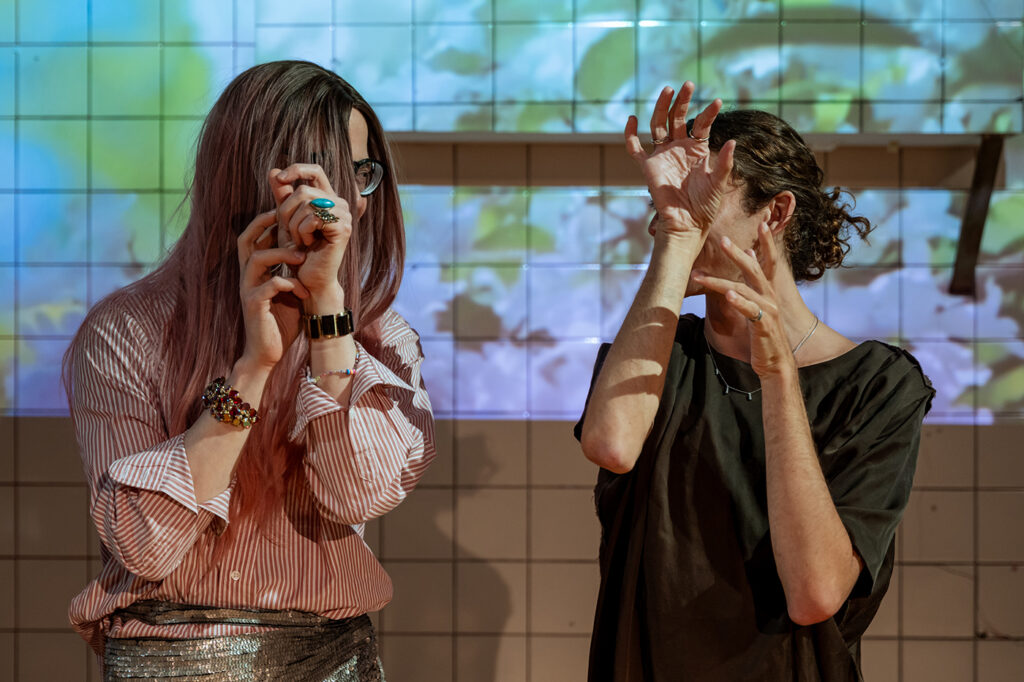
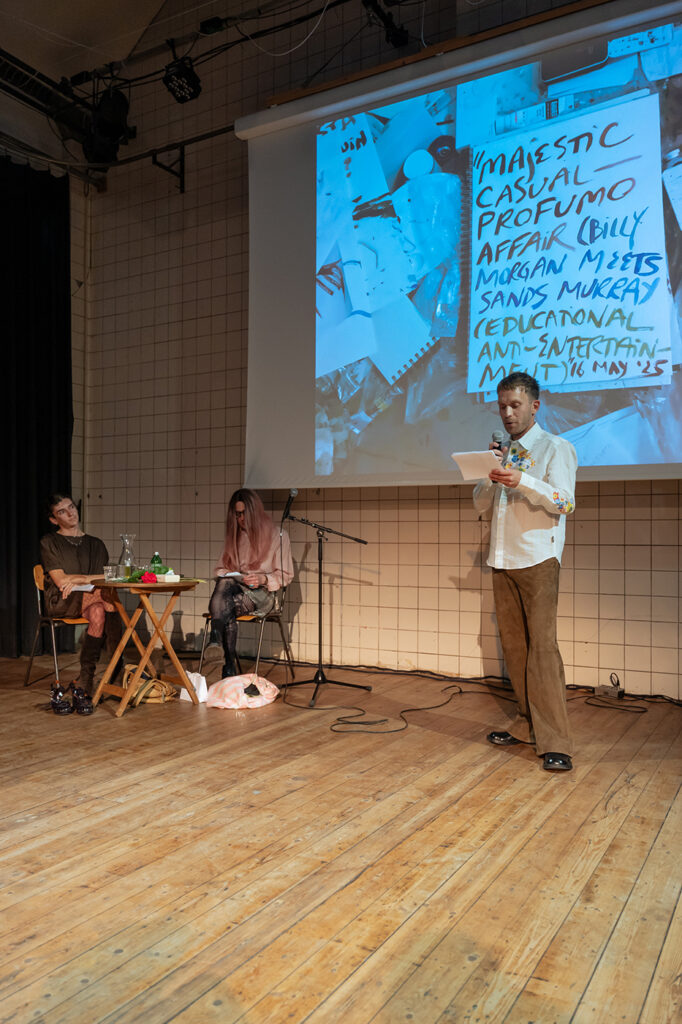
Majestic Casual — Profumo Affair: Billy Morgan meets Sands Murray (Educational Anti-Entertainment) is a collaboration between artists Billy Morgan and Sands Murray-Wassink and Titus Nouwens. It marks the first public outcome of Prelude, a series of live events emphasising interconnections and influences between moving image and performance, and between visual artists of distinct generations.
Majestic Casual –– Profumo Affair: Billy Morgan meets Sands Murray (Educational Anti-Entertainment) is een samenwerking tussen kunstenaars Billy Morgan en Sands Murray-Wassink en curator Titus Nouwens. Het is het eerste publieke programma van Prelude, een reeks live evenementen die de onderlinge verbanden en invloeden tussen bewegend beeld en performance en tussen beeldend kunstenaars van verschillende generaties benadrukken.
Billy Morgan was born in London in 1994, when Sands Murray-Wassink was a student at Pratt Institute in Brooklyn with artist Carolee Schneemann. Both artists eventually found their way to Amsterdam to continue their education in art. Sands’ former teacher, Carolee, became his role model, collaborator and friend, while Sands himself emerged as an important voice within Amsterdam’s artistic community. In recent years, his emphasis on the influences, friendships and other relationships that inform his work––and its use of his body, thoughts, feelings, emotions, and behavior as art materials––inspires a young generation of artists and curators internationally. “Sharing information as if it were a brushstroke, which it is,” he writes. In the spirit of such intergenerational exchange, Titus Nouwens brings together the work of Sands and Billy in a sort of extended blind date.
Language connects their two bodies of work. Language and embodiment. “Language is somehow the basis of art, no matter how it is spoken, written, recorded, used. It is a form of communication surpassing the visual, it comes from the body, relates to it, and the success of artists has mainly to do with how they talk about and frame their works with language” Sands writes to Billy. “What I love in the world is its associative nature – that things and feelings remind me of other things and feelings, that these can be captured by words” writes Billy to Sands. The artists’ associative and analytical thinking expresses itself in precise yet uncomplicated language, full of humor and feeling. Sands through text-paintings characterised by honesty. Billy through texts that they activate with voice and movement; texts that play with fictionality and activate the audience’s imagination.
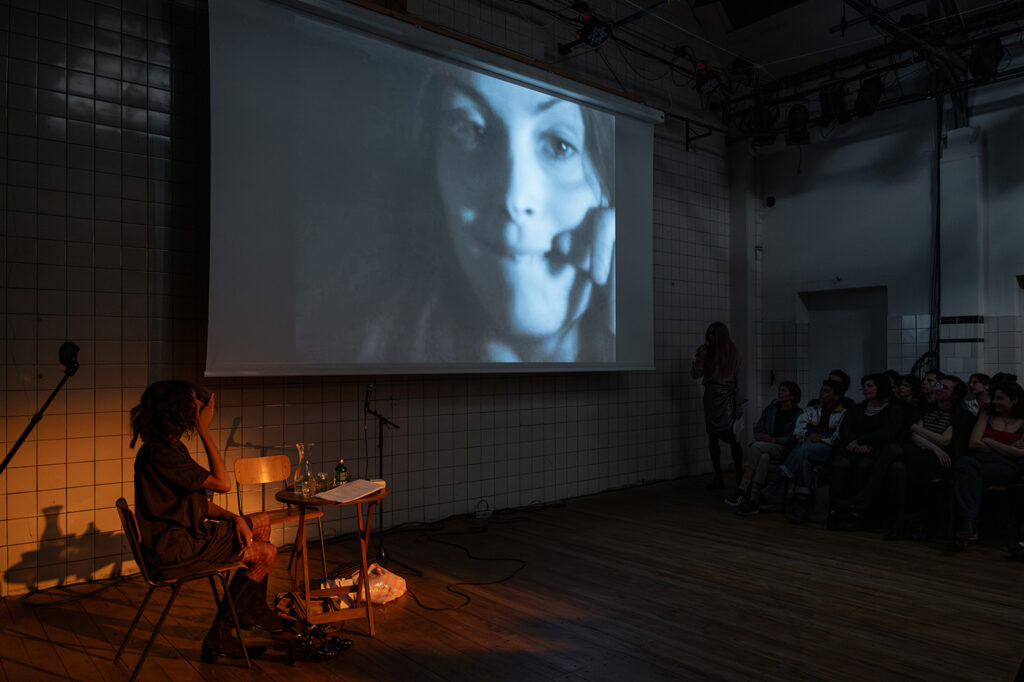
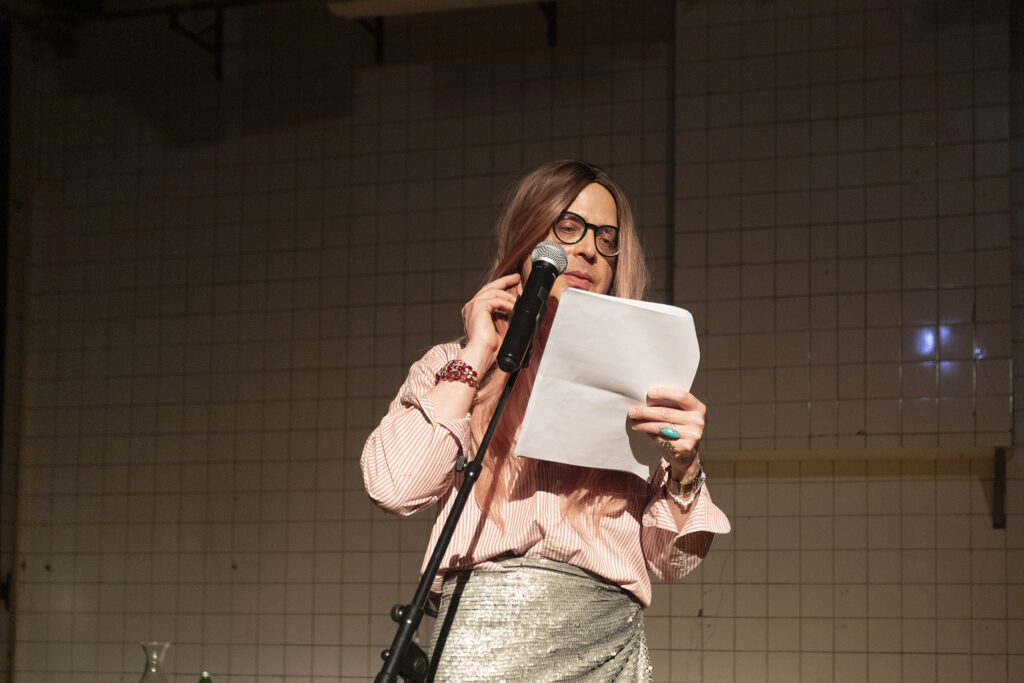
During the evening at Perdu, Sands and Billy embody each other’s language and show each other “how it’s done.” The program brings together materials and texts produced and gathered over the past months through an email correspondence. These include fragments of works by older generations of female artists from the US and Poland – Adrian Piper, Carolee Schneemann, Hannah Wilke and Małga Kubiak – that have been foundational to Sands and Billy respectively.
Using video projections, music, text recitation and interaction, Sands and Billy uncover a budding relationship and build bridges based on the idea that education is possible in all directions and at all stages of life. In this highly experimental program, Sands and Billy present something transformative for both themselves and the audience who complete the work.
About the artists:
Sands Murray-Wassink was born 17 March, 1974 in Topeka, Kansas, USA and lives and works in Amsterdam since 1994. He is a painter, body artist, writer, perfume collector indebted to various forms and permutations of intersectional feminist and queer art. He is bipolar and his career has been marked by exclusion. Influences such as Carolee Schneemann, Hannah Wilke, and Adrian Piper serve as foundational coordinates for his practice. Lived experience is paramount, as “the personal is political” and urgent for all in our world. Recent solo presentations were realised with Auto Italia, London; Le Confort Moderne, Poitiers; diez gallery and If I Can’t Dance, Amsterdam. All pertinent information about his work and trajectory can be found on the internet.
Billy Morgan was born on the 23 February, 1994 and grew up in London, UK. Their turn towards art-making took place during the two years that they lived in Warsaw, from 2018 to 2020. This was a formative period of change, learning, resistance and relations. From their beginnings in poetry-writing, and influenced by their friendships and collaborations, they have built a practice structured around language and embodiment. They continue to narrate a splitness inherent to their experience, with a light disregard for medium. Recent solo presentations were realised with ICA, London; ROZENSTRAAT, Amsterdam; marytwo, Luzern and Les Urbaines, Lausanne.
Billy Morgan werd geboren in Londen in 1994, toen Sands Murray-Wassink studeerde aan het Pratt Institute in Brooklyn bij kunstenaar Carolee Schneemann. Beide kunstenaars vonden uiteindelijk hun weg naar Amsterdam om hun kunstopleiding voort te zetten. Sands z’n vroegere docent, Carolee, werd zijn rolmodel, samenwerkingspartner en vriendin, terwijl Sands zelf een belangrijke stem werd binnen de Amsterdamse artistieke gemeenschap. De laatste jaren is zijn nadruk op de invloeden, vriendschappen en andere relaties die bepalend zijn voor zijn werk – en het gebruik van lichaam, gedachten, gevoelens, emoties en gedrag als zijn materialen – internationaal een inspiratiebron voor een jonge generatie kunstenaars en curatoren. “Informatie delen alsof het een penseelstreek is, wat het ook is,” schrijft hij. In de geest van een dergelijke intergenerationele uitwisseling brengt Titus Nouwens het werk van Sands en Billy samen in een soort ‘extended blind date’.
Taal verbindt hun twee oeuvres. Taal en belichaming. “Taal is op de een of andere manier de basis van kunst, ongeacht hoe het gesproken, geschreven, opgenomen of gebruikt wordt. Het is een vorm van communicatie die het visuele overstijgt, het komt van het lichaam, heeft ermee te maken, en het succes van kunstenaars is vooral te danken aan de manier waarop ze over hun werk praten en het vormgeven met taal”, schrijft Sands aan Billy. “Waar ik van hou in de wereld is de associatieve aard ervan – dat dingen en gevoelens me herinneren aan andere dingen en gevoelens, dat deze kunnen worden gevangen in woorden” schrijft Billy aan Sands. Het associatieve en analytische denken van de kunstenaars uit zich in precieze maar ongecompliceerde taal, vol humor en gevoel. Sands door middel van tekst-schilderijen die gekenmerkt worden door eerlijkheid. Billy door teksten die hen activeert met stem en beweging; teksten die spelen met fictionaliteit en die de verbeelding van het publiek activeren.
Tijdens de avond in Perdu belichamen Sands en Billy elkaars taal en laten ze elkaar zien “hoe het moet”. Het evenement brengt materialen en teksten samen die de afgelopen maanden door de kunstenaars zijn geproduceerd en verzameld via een e-mailcorrespondentie. Zo zijn er fragmenten te zien van werken van oudere generaties vrouwelijke kunstenaars uit de VS en Polen – Adrian Piper, Carolee Schneemann, Hannah Wilke en Małga Kubiak – die voor respectievelijk Sands en Billy van fundamenteel belang zijn geweest.
Met behulp van videoprojecties, muziek, tekstvoordrachten en interactie leggen Sands en Billy een ontluikende relatie bloot en bouwen ze bruggen vanuit het idee dat educatie mogelijk is in alle richtingen en in alle stadia van het leven. In dit zeer experimentele avondevenement hopen Sands en Billy iets te presenteren dat transformerend is voor zowel henzelf als het publiek dat het werk voltooit.
Over de kunstenaars:
Sands Murray-Wassink is geboren op 17 maart 1974 in Topeka, Kansas, VS en woont en werkt sinds 1994 in Amsterdam. Hij is schilder, body artist, schrijver en parfumverzamelaar en is schatplichtig aan verschillende vormen en samenstellingen van intersectionele feministische en queer kunst. Hij is bipolair en zijn carrière is gekenmerkt door uitsluiting. Invloeden zoals Carolee Schneemann, Hannah Wilke en Adrian Piper dienen als basiscoördinaten voor zijn praktijk. Ervaringen uit het leven staan voorop, want “het persoonlijke is politiek” en dat is urgent voor iedereen in onze wereld. Recente solopresentaties werden gerealiseerd bij Auto Italia, Londen; Le Confort Moderne, Poitiers; diez gallery en If I Can’t Dance, Amsterdam. Alle relevante informatie over zijn werk en werkwijze is te vinden op het internet.
Billy Morgan werd geboren op 23 februari 1994 en groeide op in Londen, Groot-Brittannië. Hun overstap naar het maken van kunst vond plaats tijdens de twee jaar dat hen in Warschau woonde, van 2018 tot 2020. Dit was een vormende periode van verandering, leren, verzet en relaties. Vanaf hun eerste ervaringen met het schrijven van poëzie, en beïnvloed door hun vriendschappen en samenwerkingen, heeft Billy een praktijk opgebouwd die gestructureerd is rond taal en belichaming. Terugkomend zijn verhalen van een gespletenheid die inherent is aan hun levenservaring, met een lichte minachting voor medium-specifieke conventies. Recente solopresentaties werden gerealiseerd bij ICA, Londen; ROZENSTRAAT, Amsterdam; marytwo, Luzern en Les Urbaines, Lausanne.
Tickets for Prelude events can be purchased via the websites of the venues where the program takes place.
Kaarten voor Prelude-evenementen zijn te koop via de websites van de locaties waar het programma plaatsvindt.
Editions of Prelude take place at different partner organisations.
Edities van Prelude vinden plaats bij verschillende partner organisaties.
info@prelude.nu
Instagram: @prelude.nu
Colophon
Founder and curator
Titus Nouwens
Visual identity and design
Edoardo Ferrari
Prelude is supported by
Amsterdam Fonds voor de Kunst
Jan van Beelenfonds
Perdu
de Brakke Grond
Prelude wordt mede mogelijk gemaakt door
Amsterdam Fonds voor de Kunst
Jan van Beelenfonds
Perdu
de Brakke Grond